
Lumbar Spinal Fusion Surgery: When You Need It, What It Costs & What to Expect
Dr Sanyam Jain — Best Spine Surgeon in East Delhi, Noida, Ghaziabad, Indirapuram & Patparganj
Introduction
Your doctor has said the words you were dreading: “You may need lumbar spinal fusion surgery.” And now you have a hundred questions. Is it really necessary? How long will recovery take? What will it cost? Will I be able to walk normally again?
If you live in East Delhi, Noida, Ghaziabad, Indirapuram, or Patparganj, this guide is written for you. By the end, you will know exactly what lumbar fusion surgery involves, when it is the right choice, and why hundreds of patients in Delhi NCR trust Dr Sanyam Jain, MS Ortho Gold Medalist, for their spine care.
What Is Lumbar Spinal Fusion Surgery?
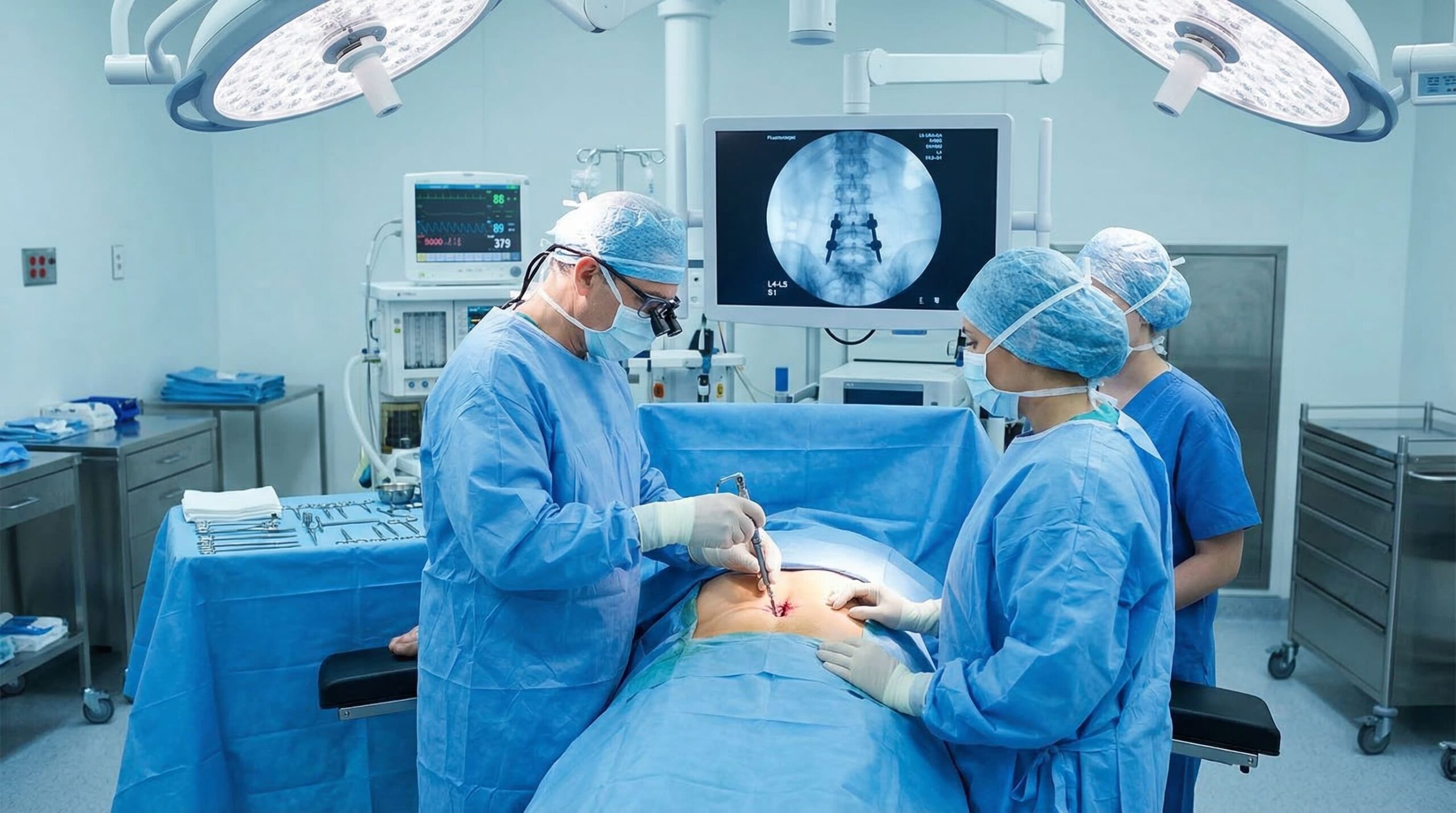
Lumbar spinal fusion surgery is a procedure where two or more vertebrae in your lower back are permanently joined using bone graft, metal rods, screws, or cages. The goal is to eliminate painful movement between unstable or damaged vertebrae and relieve pressure on compressed nerves.
Think of it this way: if the shock-absorber disc between two vertebrae is severely damaged, fusion locks that segment in place so it can no longer cause pain with every movement you make.
It is among the most commonly performed spine surgeries globally, and when performed by an expert such as Dr. Sanyam Jain at Max Hospital Patparganj, the outcomes are consistently excellent.
When Is Lumbar Spinal Fusion Surgery Necessary?
Not every back pain requires surgery. Dr Sanyam Jain always recommends exhausting non-surgical options first. However, surgery becomes the right answer when:
- Medications, physiotherapy, and injections have failed after 3 to 6 months of treatment
- You have progressive weakness, numbness, or tingling in your legs
- You are experiencing loss of bladder or bowel control. This is a medical emergency; act immediately
- Your MRI clearly shows nerve compression or spinal instability
- Pain is severely affecting your sleep, work, and daily activities
- You have been diagnosed with spinal instability, spondylolisthesis, or deformity
- A previous spine surgery has failed to relieve your symptoms
If you are experiencing leg weakness or loss of bladder/bowel control, do not wait. Consult Dr Sanyam Jain immediately at Spine Cure Clinic, Indirapuram or Max Hospital, Patparganj.
Conditions That May Require Lumbar Fusion Surgery
Dr. Sanyam Jain commonly performs lumbar fusion surgery for these diagnosed conditions:
- Degenerative Disc Disease — The disc wears down over time, causing vertebrae to grind against each other and producing chronic pain.
- Spondylolisthesis — One vertebra slips forward over another, compressing nerves and destabilising the spine.
- Lumbar Spinal Stenosis — The spinal canal narrows, squeezing nerves and causing pain and heaviness in the legs while walking.
- Severe Herniated Disc — A ruptured disc pressing on a nerve root causes radiating leg pain (sciatica) that does not respond to conservative treatment.
- Spinal Fractures — Trauma or osteoporosis-related fractures that destabilise the spine.
- Failed Back Surgery Syndrome — Persistent pain after a previous spine surgery that requires revision and stabilisation.
- Scoliosis or Kyphosis — Abnormal spinal curvature causing pain, deformity, or nerve compression.
Types of Lumbar Spinal Fusion Surgery
The technique your surgeon chooses depends on your specific diagnosis, the levels involved, and your overall health. Here are the four most common approaches:
1. PLIF — Posterior Lumbar Interbody Fusion
Performed from the back. The surgeon removes the damaged disc, places a bone graft or cage between the vertebrae, and secures everything with rods and screws. It is the most widely used fusion technique and is effective for disc disease, stenosis, and instability.
2. TLIF — Transforaminal Lumbar Interbody Fusion
An advancement over PLIF that approaches from a slightly different angle, reducing nerve risk and blood loss. Dr. Sanyam Jain prefers this technique for spondylolisthesis and recurrent disc herniation because it offers excellent outcomes with lower complication rates.
3. ALIF — Anterior Lumbar Interbody Fusion
Performed through the abdomen, leaving the back muscles completely untouched. This results in less post-operative muscle pain and excellent disc space restoration. It is particularly effective for L4-L5 and L5-S1 levels with advanced degenerative disc disease.
4. Minimally Invasive Lumbar Fusion (MIS Fusion)
Using specialised retractors and real-time imaging, the procedure is done through incisions of just 2 to 3 cm. MIS fusion means significantly less blood loss, less muscle damage, shorter hospital stay, faster return to daily life, and lower infection risk. Dr Sanyam Jain is trained in MIS techniques and recommends them whenever clinically appropriate.
How Long Does Lumbar Spinal Fusion Surgery Take?
Duration depends on the number of levels fused and the technique used:
- Single-level MIS fusion: approximately 1.5 to 2.5 hours
- Single-level open fusion (PLIF/TLIF): approximately 2 to 3 hours
- Multi-level fusion: 3 to 5 hours, depending on complexity
- If combined with decompression (laminectomy), add 30 to 60 minutes
You will be under general anaesthesia throughout. Intraoperative nerve monitoring is used to protect your spinal cord and nerve roots at all times.
Lumbar Spinal Fusion Surgery Success Rate
When performed on the right patient for the right condition, lumbar fusion surgery achieves significant pain relief and improved function in 70% to 90% of cases. Success is highest when:
- The correct diagnosis has been made through MRI and clinical evaluation
- The patient is not a smoker; nicotine significantly inhibits bone fusion
- The patient follows the prescribed physiotherapy programme consistently
- An experienced, subspecialty-trained surgeon performs the procedure
- The patient maintains a healthy weight after surgery
Dr Sanyam Jain’s outcomes at Max Hospital Patparganj consistently align with international benchmarks for spine fusion surgery, backed by years of subspecialty training and a patient-first philosophy.
What to Expect After Lumbar Spinal Fusion Surgery
Here is your honest, stage-by-stage picture of life after lumbar fusion surgery:
| Timeframe | What Happens |
| Day 1 – 2 | You are in the hospital. Medication helps to control pain. You will be helped to stand and take a few steps with a walker on the same day as the treatment. |
| Day 3 – 4 | Hospitalisation has ended. You are sent home with medication, wound care instructions, and follow-up appointments. |
| Week 1 – 3 | Get a rest at home. Every few hours, light walking is recommended. There will be no bending, lifting, or twisting. |
| Week 4 – 8 | Get a rest at home. Every few hours, light walking is recommended. There will be no bending, lifting, or twisting. |
| Month 2 – 3 | Most patients return to their desks or offices. Short-distance driving is frequently tolerated. |
| Month 3 – 6 | Activity gradually increases. Most daily tasks return to normal. Pain continues to reduce. |
| Month 6 – 12 | Bone fusion is complete. Full activity, including light exercise, resumes for most patients. |
Lumbar Spinal Fusion Surgery Recovery Time
Recovery time is the number one question patients ask before surgery. Here is the honest answer:
- Minimally invasive single-level fusion: back to light activity in 4 to 6 weeks; full recovery in 3 to 4 months
- Open single-level fusion: limited activity for 6 to 8 weeks; full recovery in 4 to 6 months
- Multi-level open fusion: restricted activity for 3 months; bone fusion complete by 9 to 12 months
- Office or desk job: most patients return in 6 to 8 weeks
- Physical or field job: 3 to 6 months, depending on the nature of work
Tips for a Faster, Smoother Recovery
- Start physiotherapy as soon as your surgeon clears you — it is as important as the surgery itself
- Stop smoking completely — nicotine is the single biggest preventable cause of failed bone fusion
- Do not skip follow-up appointments — bone fusion progress needs to be monitored
- Eat a calcium, vitamin D, and protein-rich diet to support bone healing
- Use your back brace as instructed — it protects the fusion site during healing
- Walk short distances frequently — movement reduces blood clot risk and speeds recovery
- Maintain a positive mindset — the vast majority of patients achieve excellent outcomes
Why Choose Dr. Sanyam Jain — Best Spine Surgeon in East Delhi, Noida, Ghaziabad, Indirapuram & Patparganj?
If you are looking for a spine surgeon you can trust, not just a hospital name, Dr. Sanyam Jain is the answer for patients across East Delhi, Noida, Ghaziabad, Indirapuram, and Patparganj.
- MS Ortho Gold Medalist — Academic excellence at the highest level; DrDrain trained at the very top of his batch.
- Max Hospital Patparganj — One of Delhi’s premier multi-speciality hospitals with world-class spine OT infrastructure and ICU support.
- Spine Cure Clinic, Indirapuram — An accessible outpatient clinic for consultations, follow-ups, and second opinions without long hospital queues.
- Minimally Invasive Expertise — Trained in MIS fusion techniques for smaller incisions, less pain, and faster recovery.
- Surgery as Last Resort — Dr Sanyam Jain will never recommend surgery if non-surgical options can still work. His first consultation is always about solving your problem honestly.
- Transparent Communication — Every patient receives a clear diagnosis, clear options, clear expectations, and clear costs before any decision is made.
- Trusted Across Delhi NCR — Patients from East Delhi, Vaishali, Indirapuram, Greater Noida, and beyond have built their trust through outcomes, not advertising.
FAQ ( Frequently Asked Question )
Is lumbar spinal fusion surgery permanent?
Yes. Once bone fusion is complete, typically within 6 to 12 months, the fused vertebrae become a single, permanent unit. The metal hardware (rods and screws) is usually left in place permanently and causes no long-term discomfort in the vast majority of patients.
What is the success rate of lumbar spinal fusion surgery in India?
Clinical data sshowa 70% to 90% success rate for significant pain relief and functional improvement when surgery is performed on appropriate candidates. At Max Hospital Patparganj, Dr Sanyam Jain’s outcomes align with international benchmarks for minimally invasive spine fusion.
Is minimally invasive lumbar fusion better than open surgery?
For eligible patients, yes. MIS fusion offers less blood loss, less post-operative pain, a shorter hospital stay of 1 to 2 days compared to 3 to 5 days for open surgery, and a faster return to daily life. However, complex deformity or multi-level disease may still require open surgery. Dr Sanyam Jain will recommend the safest and most effective option for your individual case.
Does insurance cover lumbar spinal fusion surgery in India?
Most health insurance policies, including CGHS, ECHS, and major TPA plans, cover lumbar fusion surgery when it is medically indicated and documented. Max Hospital Patparganj has a dedicated insurance and billing support team to help you with pre-authorisation and claim processing.
How long after lumbar fusion surgery can I return to work?
For a desk or office job, most patients are cleared to return within 6 to 8 weeks. For physically demanding work involving lifting or manual labour, 3 to 6 months of rest and rehabilitation is recommended. Your surgeon will advise specifically based on your job profile and healing progress at each follow-up visit.
Where can I consult a spine surgeon near Indirapuram or Ghaziabad?
Dr Sanyam Jain sees patients at Spine Cure Clinic, Indirapuram, easily accessible from Vaishali, Kaushambi, Noida Sector 62, and Ghaziabad. He also operates at Max Hospital Patparganj, East Delhi. You do not need to travel to AIIMS or Safdarjung for world-class spine surgery.
What happens if lumbar fusion surgery does not work?
In a small percentage of cases, patients may develop adjacent segment disease, increased stress on discs above or below the fused segment, or incomplete fusion (pseudarthrosis). Both conditions can often be addressed with revision surgery or targeted intervention. The best way to avoid these outcomes is to choose an experienced surgeon and follow all post-operative instructions carefully.
Ready to Take the Next Step? Consult Dr Sanyam Jain Today.
Lumbar spinal fusion surgery is not a decision to make lightly or to delay unnecessarily. If you have been living with chronic back pain, leg weakness, or sciatica that is not responding to treatment, the answer you are looking for is one consultation away.
Dr Sanyam Jain, MS Ortho Gold Medalist, brings together the diagnostic precision, surgical expertise, and honest communication that every spine patient deserves. Whether you need a second opinion, an MRI review, or are ready to explore surgical options, he will give you a clear, unbiased answer without any pressure.
Patients across East Delhi, Noida, Ghaziabad, Indirapuram, and Patparganj no longer need to travel far for world-class spine surgery. It is right here, close to home.
Spine Cure Clinic, Indirapuram, Ghaziabad | Max Hospital, Patparganj, East Delhi
Dr Sanyam Jain — MS Ortho Gold Medalist | Best Spine Surgeon in East Delhi, Noida, Ghaziabad, Indirapuram, Patparganj